A Response to Bishop Schneider's Request
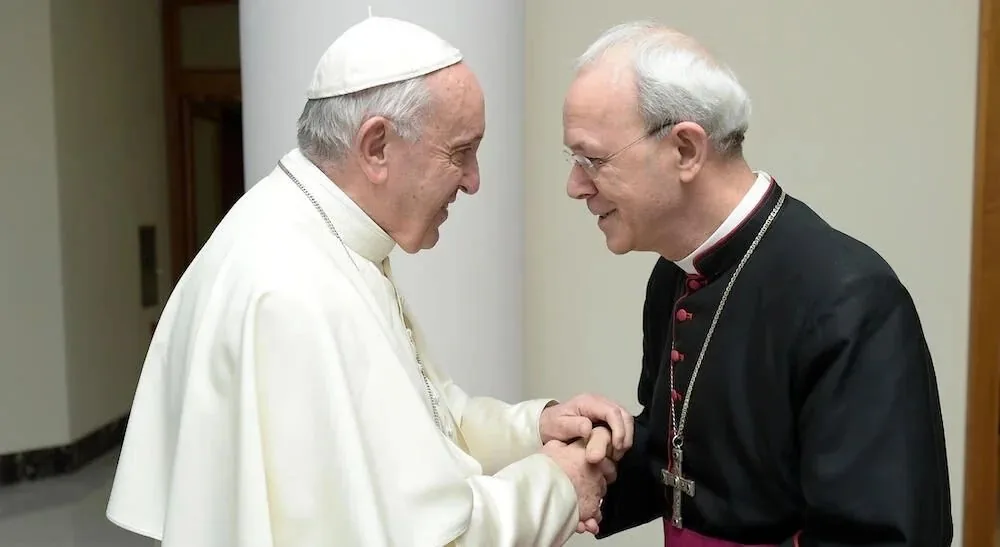
Bishop Athanasius Schneider has addressed a plea to the Holy Father to grant the mandatum for the upcoming episcopal ordinations of the Priestly Society of St. Pius X (SSPX), scheduled for July 1, 2026: “Most Blessed Father, if you grant the Apostolic Mandate for the episcopal consecrations of the FSSPX, the Church of our day will lose nothing. You will be a true bridge builder and, even more, an exemplary bridge builder, because you are the Supreme Pontiff, Summus Pontifex.”
The content of this plea is, in truth, very problematic and shows quite clearly that His Excellency does not have a correct understanding of the SSPX and what it really wants from the Holy See. "It would be a tragedy if the SSPX were to become completely isolated, and the responsibility for such a division would fall mainly on the Holy See. The Holy See should welcome the SSPX, offering at least a minimum of ecclesial integration, and then continue the doctrinal dialogue," claims Bishop Schneider.
But reading this complaint, one wonders whether there is sufficient knowledge of what has happened in the history of the dialogues between the Holy See and the SSPX and of what, just a few days ago, the Dicastery for the Doctrine of the Faith proposed to the Society itself.
In fact, precisely in order to find that minimum necessary, the Holy See asked the Society to reopen dialogue, suspending the decision to consecrate bishops next summer. And it is well known that it was the superior general, together with his assistants and advisors, who refused to engage in “a doctrinal dialogue that was too forced and lacked sufficient serenity.” Furthermore, that minimum, as expressed by Cardinal Fernández, would have included necessary and important clarifications—sponsored by Schneider himself—so as not to require assent of faith to statements of the Second Vatican Council that are not dogmatic.
What Bishop Schneider seems not to realize is that, at least since the last General Chapter that elected Father Davide Pagliarani as superior general, the line of the SSPX has become one of rejecting in advance any agreement with the Holy See and demanding instead that the Pope recognize the Society as it is, that is, in the exercise of its ministry outside hierarchical communion, which Don Pagliarani has called “our situation of exception.”
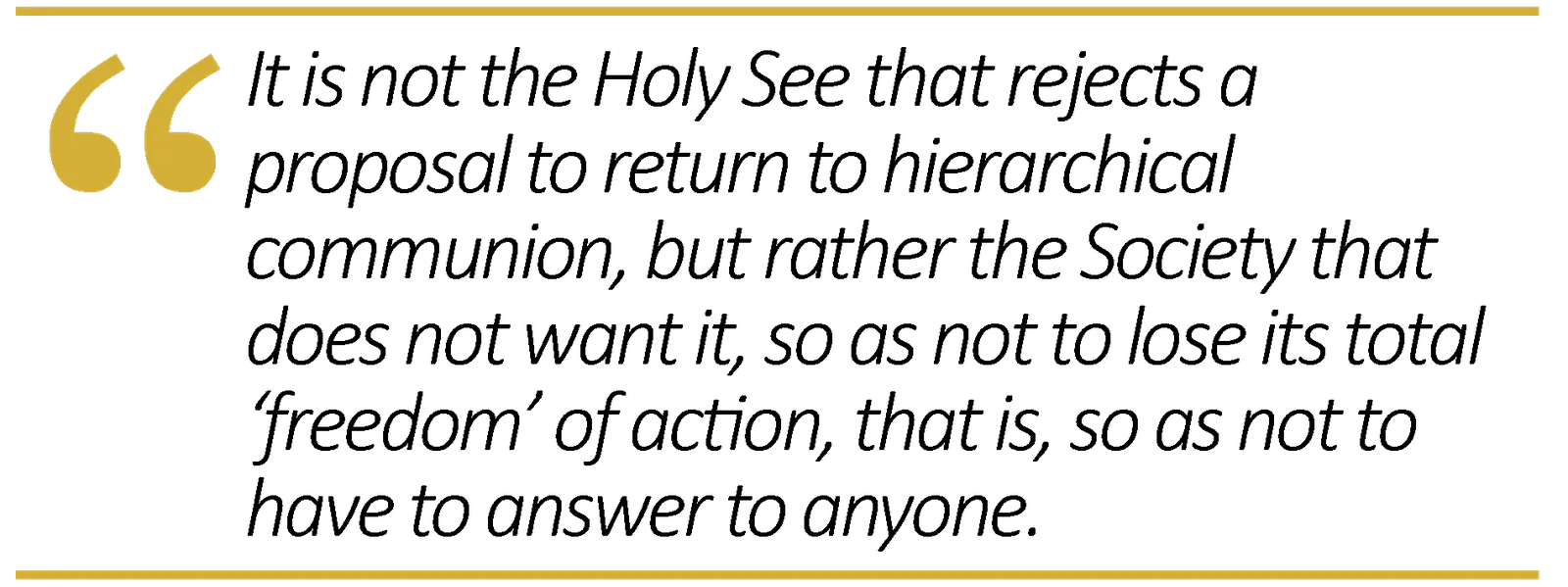
We will have occasion to document this line of the SSPX more extensively using documents belonging to the Society itself, but it is already quite clear that it is not the Holy See that rejects a proposal to return to hierarchical communion, but rather the Society that does not want it, so as not to lose its total “freedom” of action, that is, so as not to have to answer to anyone.
So that the reader understands that this is not a matter of prejudice, we quote an excerpt from a letter that the new superior general sent to all SSPX priests on November 22, 2018, after his first meeting with representatives of the Congregation for the Doctrine of the Faith, a letter that marked the decision to end all dialogue aimed at regularization:
"Even if tomorrow the Roman authorities were to retrace their steps and propose an acceptable statement of principles, what guarantee would we have that the next day that statement would still be sufficient for our interlocutors? We see in this a clear sign of Providence: the succession of these unsatisfactory drafts of a doctrinal statement and their continuous revision seem to have run their course. ... Everything therefore urges us to courageously resume our theological discussion, well aware that the Lord does not necessarily ask us to convince our interlocutors, but above all to bring before the Church the unconditional witness of faith."
It is quite clear that the Society does not intend to accept any regularization: the dialogues are understood as a “testimony of faith,” not as steps toward a minimal agreement.
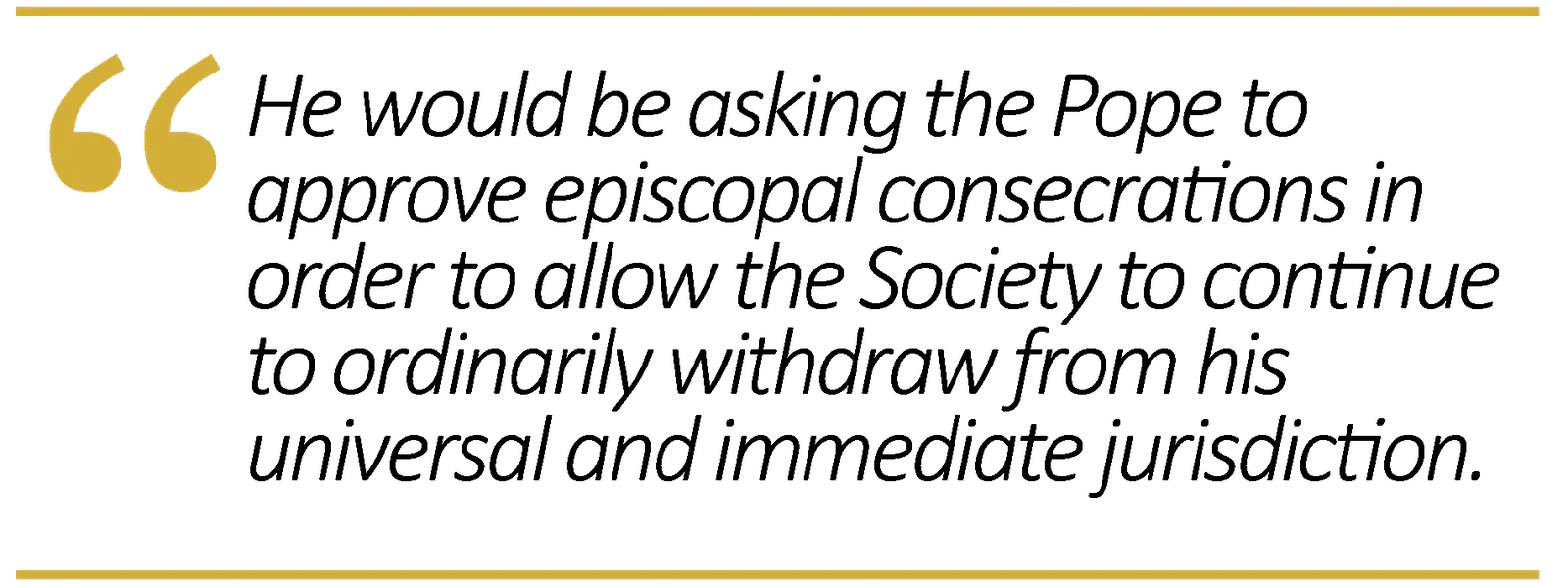
It is difficult to understand, then, how Bishop Schneider can beg the Pope to grant the Apostolic Mandate under these conditions; he would be asking the Pope to approve episcopal consecrations in order to allow the Society to continue to ordinarily withdraw from his universal and immediate jurisdiction. His Excellency accuses those who, according to him, have elevated “the canonical and legal dimension ... to the supreme criterion” of “a certain legal positivism,” but one cannot help but see in his conception of the mandatum a legal positivism no less significant, since he seems to be asking for the mandate for an episcopal consecration that is not “legally” but juridically outside the Church. The two adverbs are not synonymous: juridical communion belongs to the divine constitution of the Church and is inalienable, while the legal and canonical dimension, through which that juridical bond is expressed, is variable.
Here arises another substantial misunderstanding of the appeal, when Bishop Schneider accuses those who highlight the contradictions of the Society of confusing disobedience with schism and of having confused “the acceptance of papal primacy as revealed truth with the specific forms of its exercise.” Schneider accuses those who highlight the contradictions of the Society of confusing disobedience with schism and of having confused “the acceptance of papal primacy as revealed truth ... with the concrete forms—forms that have evolved throughout history—by which a bishop expresses his hierarchical unity with the Pope.” However, the various historical modalities of appointing bishops always occurred: 1) with at least implicit approval from the Apostolic See, which recognized local customs and reserved the right of veto; 2) by bishops in hierarchical communion; 3) to consecrate bishops destined to belong to that same communion. The examples cited by Schneider (Cardinal Slipyj, St. Athanasius) confirm this rule.
None of these three elements are found in the consecrations of the SSPX, because: 1) the Holy See does not approve them and they would be performed against the explicit veto of the Supreme Pastor; 2) the consecrating bishops of the SSPX are not bound by the necessary juridical bond with the episcopal college and therefore are not Catholic bishops; 3) the new bishops would be ordained with the explicit purpose of removing themselves from the jurisdiction of the Pope and any other Ordinary. What is at stake here is not merely a “legal” matter, but the divine constitution of the Church. Is it possible to habitually remove oneself from the jurisdiction of the Pope and the diocesan bishop?
It is not a matter of opposing errors, but rather of not habitually accepting that jurisdiction and even of arrogating powers to oneself, as when the Fraternity establishes its own tribunal to decide on the validity of marriages. If the answer is negative, it is difficult to see how this choice can be defended; if it is affirmative, it would be necessary to demonstrate historically and theologically that a bishop can govern a portion of the Church outside of hierarchical communion and without a mandate from the Supreme Pastor.
It is also surprising that Bishop Schneider invokes two letters from Benedict XVI addressed to the bishops—on the occasion of the motu proprio Summorum Pontificum (July 7, 2007) and the remission of excommunications (March 10, 2009)—to “awaken the conscience of those in the Vatican who will decide on the permission of episcopal consecrations.” It was Benedict himself who opened the doors to the Society, but it was also he who set the minimum requirements for regularization: accepting that the Magisterium is the authentic interpreter of Tradition; accepting Vatican II as part of Tradition, while leaving open the discussion of problematic points; accepting the validity and lawfulness of the Novus Ordo. That minimum was rejected.
For our part, we hope that the Holy Father will be able to meet personally with the Superior General, as he desires, to hear his reasons and fears. But it is equally clear that asking the Pope to authorize episcopal consecrations without the guarantee that the ministry of those bishops will be exercised in hierarchical communion is tantamount to asking him to approve a schism.
Luisella Scrosati has a degree in Philosophy from the Catholic University of the Sacred Heart in Milan, Italy.
Translated from the original Italian from La Nuova Bussola Quotidiana