Living Stones of the Holy Land – Part II
Under the Empire: Faith Under Rome and Byzantium
Christianity was born in Palestine, not as an idea but as a way of life lived by families and disciples in the very places where Jesus walked. For two thousand years, Christians in Palestine have carried that first light through empire, war, and displacement, their quiet endurance forming an unbroken bridge between the Church’s beginnings and our own moment. This series is an invitation to walk with them — tracing how the first communities formed, how their traditions endured, and how their witness remains the living heart of a faith rooted in real people, real places, and a history that still speaks.
“For I am not ashamed of the gospel: it is the power of God for salvation to everyone who has faith, to the Jew first and also to the Greek.” -Romans 1:16
Christianity was born on the margins of power, but providence made way for it to march (with a speed that baffles historians to this day) right into the heart of an empire.
The early Church began as a persecuted minority. It was under Roman rule from Day One in 33 AD, the time of the crucifixion of Our Lord. And yet, within just a few centuries, the Church would become the favored religion of Rome. The story of Palestinian Christians under Rome and Byzantium is a story of perseverance and transformation. But it’s also a cautionary tale. A story of suffering turned into strength – and of strength sometimes forgetting the suffering that gave it birth.
From Martyrs to Monasteries
In the centuries after Pentecost, the Church in Palestine grew through witness – the kind that often ended in blood. Christians in Jerusalem and across Judea faced waves of persecution, both local and imperial. The chronicles of the Palestinian martyrs during the Diocletian persecution of 303-311 AD and their witness despite unimaginable torture and slow death is recorded by Eusebius. These men and women were accused of subversion, cannibalism, atheism – all because they refused to participate in sacrifices to the Roman gods and emperor, daring to proclaim a crucified God in the face of a similar fate themselves.
But through their blood came conversions. And through conversions came communities.
By the early 4th century, the Palestinian Church had taken firm root. Bishops were being ordained, churches built, liturgies celebrated – often in secret, sometimes in defiance of threats.
Then came Constantine.
With the Edict of Milan in 313 AD, Christianity was no longer illegal. And with Constantine’s own conversion, the Church moved from caves and catacombs to bright basilicas.
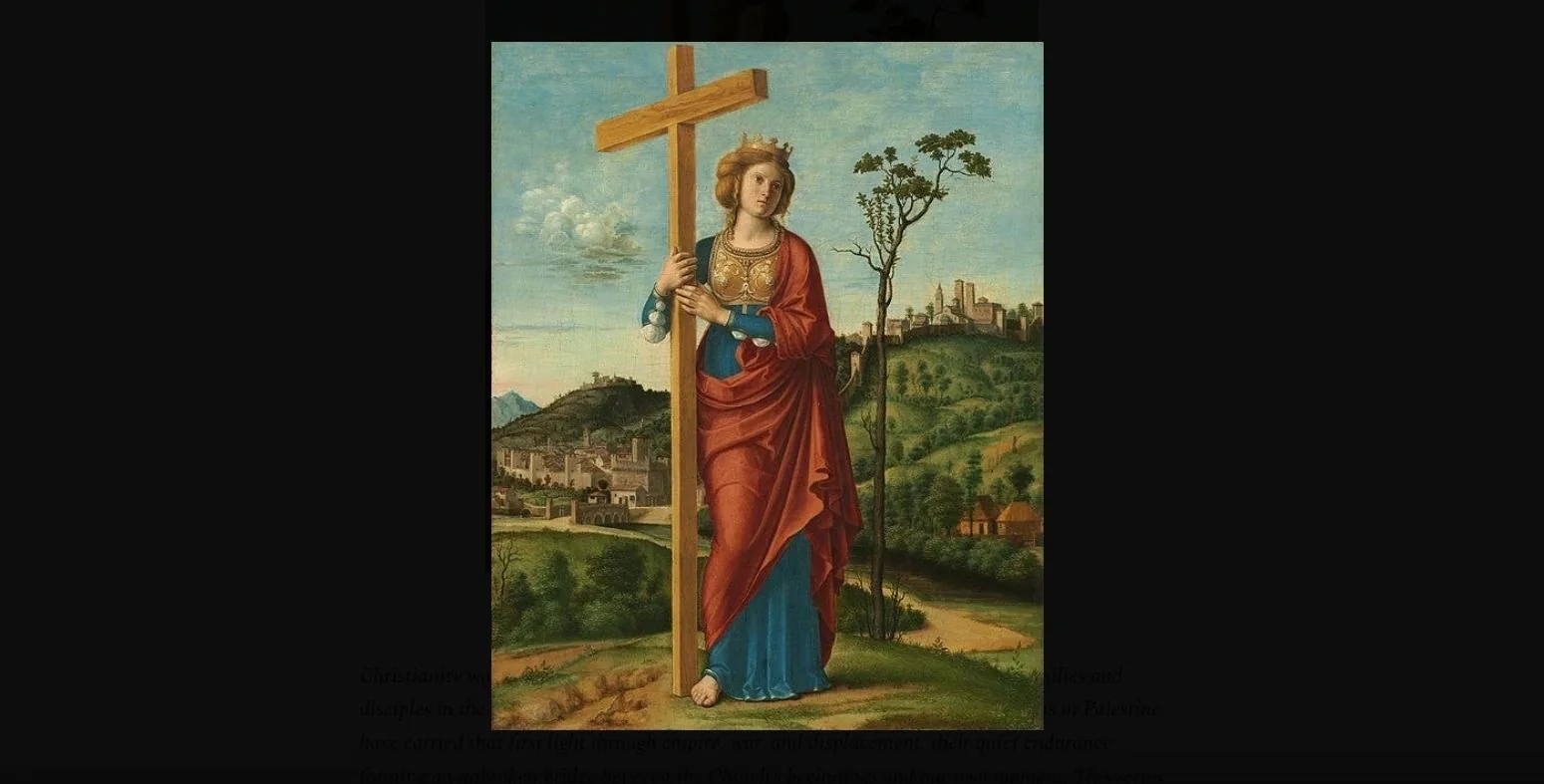
Palestine, the land of Christ’s birth, death, and resurrection, became the center of Christian pilgrimage. Empress Helena, Constantine’s mother, journeyed to the Holy Land to identify and honor the sacred sites. Under her patronage, the Church of the Nativity in Bethlehem and the Church of the Holy Sepulchre in Jerusalem were built. The land where God walked became ornamented with marble and mosaics.
Fulton Sheen reflected on that sacred geography with awe. “There is a land where no one walks without treading on history, no one speaks without echoing prophecy,” he wrote of the Holy Land.
But for the local Christians, especially the poor, the new imperial embrace was complex.
A Double-Edged Sword
Power is never neutral. With recognition and elevated prominence came advantages, but also temptations. The simple, suffering Church became an institution of high status and privilege in some places. Bishops gained influence and power. Theological disputes became imperial affairs. And often, those closest to the heart of Christ – the poor, the marginalized – were left out in the cold.
The Palestinian Church remained faithful. But it was now shaped by the empire that had once marginalized it.
One of the most profound responses to this tension came not from theologians or emperors, but from the desert.
Voices from the Wilderness
As the Church grew comfortable, some Christians fled to discomfort. In the barren hills and deserts of Palestine, a spirit of monasticism began to flourish.
Saint Hilarion, a Palestinian Christian, is credited with founding monastic life in Gaza. He was a student of St. Anthony the Great and brought the spirit of the Egyptian desert to the Holy Land.
These early monks – many of them locals – rejected worldly power, choosing instead lives of prayer, fasting, and silence. Their witness preserved the spiritual fire of the early Church and inspired generations.
The monasteries they founded became sanctuaries of faith, learning, and hospitality. Some, like Mar Saba Monastery outside Bethlehem, still stand today, clinging to desert cliffs as if in defiance of time itself.
Monasticism offered a radical reminder: the Church is not a tool of empire. It is the Body of Christ – and that body still bears the marks of the Cross.
St. Basil the Great put it this way: “A tree is known by its fruit; a man by his deeds. A good deed is never lost; he who sows courtesy reaps friendship, and he who plants kindness gathers love.”
The Ghassanids: Arab Christians Before Islam
During this same period, Arab Christians – including the Ghassanids – rose in prominence in the region. As early as the 2nd and 3rd centuries, these Arab tribes began to embrace Christianity and eventually became allies of the Byzantine Empire.
The Ghassanids governed large swaths of what is now Jordan, Syria, and southern Palestine. They were defenders of the faith, builders of churches, and protectors of pilgrims.
Their presence is crucial to remember: Arab identity and Christian identity were not at odds. Long before the rise of Islam, Arab tribes were worshiping Christ, building churches, and debating Christological doctrine.
These were Semitic Christians speaking local languages – not foreign missionaries, but indigenous believers living out the Gospel in the heart of the Levant.
As Hilaire Belloc observed, “The Church is a thing rooted deeply in the past. You cannot tear it up without destroying all the roots of Europe, and more than Europe.”
Councils, Controversies, and Communion
The Byzantine period brought with it theological richness, but also division.
Councils were convened to wrestle with profound questions: Who is Christ? Is He one person with two natures? How does His divinity relate to His humanity?
Palestinian bishops participated in these ecumenical councils – voices from the land of the Incarnation helping to define the very nature of the Incarnate Word.
But theological disagreements also fractured the Church. The Council of Chalcedon in 451 AD led to schisms that still endure today between Chalcedonian (Eastern Orthodox and Roman Catholic) and non-Chalcedonian (Oriental Orthodox) communities.
For Palestinian Christians, these theological rifts meant local divisions, shifting allegiances, and sometimes even persecution – not by pagans, but by fellow Christians.
As Chesterton later warned: “The Church is justified, not because her children do not sin, but because they do.”
Faith Carved in Stone
Despite the turmoil, the era of Byzantium left a legacy of beauty and devotion. Magnificent mosaics, ancient liturgies, and pilgrimage routes were established. The Holy Land became not just a spiritual symbol, but a living network of Christian life and witness.
Even to this day, archaeologists uncover Byzantine churches in Gaza, Nablus, and Hebron – remnants of a once-flourishing Christian civilization.
These stones tell stories of priests and pilgrims, widows and monks, and families gathering for Divine Liturgy in villages now forgotten by the modern world.
But as with every golden age, the light would cast long shadows.
A Warning from the Past
The Church under Rome and Byzantium reminds us that power can protect what is precious, but it can also compromise it. That state support can build churches, but also tempt the faithful to forget the Cross.
As we look to the present and future of Palestinian Christianity, we must remember that tension. The goal is not nostalgia for empire or longing for political dominance. The goal is fidelity – to Christ, to the poor, and to the truth.
It’s an easily forgotten truth. But when we ignore it, our forgetfulness leads to destruction.
Part 1: The First to Follow Christ: Early Christians in the Apostolic Age
(Republished with permission from the Jason Jones Show)